A Patterned Scarf for a Plain Coat: A Winter Styling Exercise
Choose a patterned scarf for a plain coat by comparing pattern scale, color, and texture, then see how a simple winter outfit changes around it.
How do you choose a patterned scarf for a plain coat without making the outfit feel busy? Start with the coat you actually wear, then compare the scarf’s colors, pattern scale, and texture against its broad, uninterrupted surface. This winter styling exercise turns one familiar pairing into a way to notice how a small piece of cloth can shift an outfit’s character.
Begin with the coat’s color and surface
Lay the coat over a chair or hold it in good natural light. Look at its main color, then notice whether the fabric reads smooth, fuzzy, nubby, or tightly woven. A charcoal wool coat, for instance, gives a different impression from a smooth navy raincoat, even if both look plain from across the room.
Choose the coat you want to wear most often, not an imaginary ideal. The scarf should work with the coat’s actual color and texture, and with the layers you tend to wear beneath it. If the coat has a visible button color, a contrasting collar, or a strong lapel shape, include those details in your first impression.
Now name the coat’s mood in a few plain words: quiet, crisp, rugged, soft, or formal. This is not a rulebook. It gives you a useful starting point for deciding whether the scarf should echo that mood or introduce a gentle counterpoint.
Choose the color relationship before the pattern
Look for a scarf that shares at least one color with the coat, a nearby layer, or an accessory you already wear. With a dark green coat, a scarf containing olive or deep brown can feel connected without matching exactly. A rust accent may add warmth while leaving the coat as the outfit’s anchor.
You can also use contrast. A pale scarf against a dark coat is easy to see, while a darker scarf against a light coat produces a different emphasis. If both pieces are highly saturated or strongly contrasting, the scarf may become the first thing people notice. That can be the point, but it is worth checking the whole outfit rather than judging the scarf alone.
Hold the scarf near the coat’s collar, then step back. A scarf draped over the front acts a little like a colored bookmark in a large, plain book: it draws the eye to one area without changing the whole object. Ask whether that patch of color connects to anything else you plan to wear. A hat, sweater, or gloves can provide the link; they do not need to match precisely.
Compare pattern scale with the coat
Pattern scale means the size of the shapes or repeats in a design. A scarf might carry fine checks, broad stripes, small dots, large blocks, or a dense paisley. The coat has visual scale too: wide lapels, oversized buttons, a pronounced herringbone weave, and a large collar all create noticeable forms, even if its overall color is solid.
For a calm pairing, try a pattern with a different scale from the coat’s main features. A coat with broad lapels can sit comfortably beside fine checks; a coat with a narrow, neat line may give a generous plaid room to show. If the coat is truly smooth and spare, either scale can work. Small patterns often read as texture from a distance, while large ones remain legible across the room.
Check what happens when the scarf is folded or wrapped. A large motif may disappear into a knot, leaving only an indistinct patch of color. A small repeat can remain busy when gathered close to the face. Spread the scarf out, then bunch it loosely as you would wear it; the visible portion matters more than the design laid flat.
Match texture and weight to the coat
Texture changes how a pattern feels. A brushed wool scarf softens a crisp coat; a smooth woven scarf can look clean beside a fuzzy surface. A fringe, raised weave, or heavy border also adds detail, so consider whether the print or weave already provides enough interest.
Think about how the scarf will sit at the neck. A thick scarf can create bulk under a narrow collar, while a light one may disappear beside a substantial lapel. You are choosing for comfort as well as appearance: a scarf that is awkward to wrap or irritating against the skin is unlikely to become a useful partner for the coat.
Care can narrow the choice, too. Check the care label on both pieces before making them regular companions. If a scarf needs handling that does not fit your routine, reserve it for occasional wear rather than building the outfit around it.
Test the pairing as a complete outfit
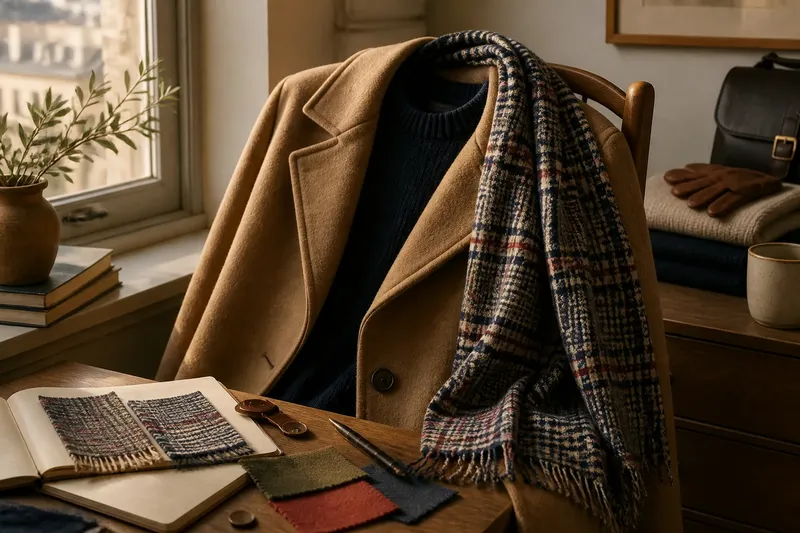
Say you have a plain camel coat, a navy sweater, and a scarf with small navy checks, cream lines, and a muted red accent. Hold the scarf at the coat’s neckline first. The navy links it to the sweater, the cream lifts the camel, and the small check keeps the pattern from overpowering the coat’s broad surface. Put the outfit on and look in a mirror from a few steps away. If the red accent pulls your eye too sharply, turn the scarf so less of it shows; if the combination feels too quiet, let more of the pattern sit across the front.
Try the scarf in the way you would wear it outdoors, not only as a loose drape. A single wrap, a simple tuck, or an open fold changes which colors and motifs remain visible. Keep the coat fastened if that is how you usually wear it, since the front opening can interrupt the pattern or reveal another color underneath.
Then add the shoes and bag you expect to carry. They need not repeat the scarf, but their color and finish should not introduce an unrelated focal point. If the outfit starts to feel crowded, remove one competing accent rather than searching for another item to coordinate.
What should you check before choosing a scarf?
Should the scarf match the coat exactly?
No. A shared color can connect the pieces, while a nearby shade keeps the pairing from looking like a set. Exact matching is only one option, not a requirement.
Does a plain coat work better with a large pattern?
Not automatically. A plain coat leaves room for a large motif, but a fine pattern may suit its shape and the way you wear the scarf more naturally. Compare both at the coat’s neckline and at a distance.
Can I wear two patterns at once?
Yes, if their scales and colors do not compete for attention. Keep one pattern quieter or more widely spaced, such as a fine-striped sweater beneath a scarf with broader checks.
What if the scarf looks different indoors?
Check it in daylight and in the lighting where you usually leave home. Indoor bulbs can shift how colors appear, so judge the pairing in the conditions in which you expect to wear it.
Make the choice easy to repeat
Once a pairing feels right, note the simple reason: shared navy, contrasting light color, or a fine pattern against broad coat details. That gives you a decision you can use with another scarf without turning winter dressing into a matching puzzle.
A patterned scarf for a plain coat does not need to transform the outfit. The useful choice is the one whose scale reads clearly, whose colors belong with the layers you already wear, and whose texture feels comfortable at the collar. Try the same pairing with the coat open and closed; that final check tells you whether the scarf works with the coat as clothing, not just as a color sample.