Curtains or Blinds: Two Ways to Frame a Window
Curtains or blinds can change how much of a window stays visible. Compare folds, edges, and placement to choose a frame that suits the room.
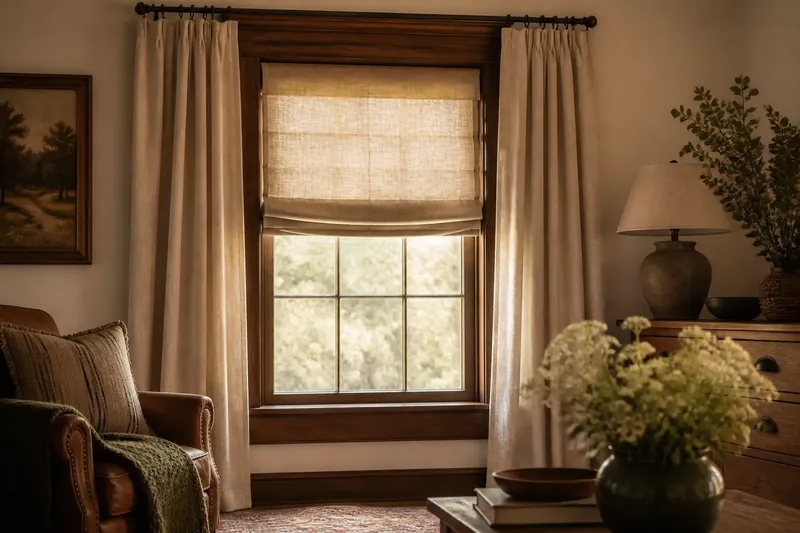
Are curtains or blinds making your window look smaller, busier, or less balanced than it should? Curtains or blinds can change the window’s outline as much as its color: one treatment gathers at the sides, while another covers or reveals the glass in a flatter plane.
That difference matters in Western interiors, where timber trim, woven textures, and substantial furnishings can make a window feel like part of the room’s architecture. A curtain can echo a relaxed, layered character. A blind can leave the casing and wall more exposed. Neither is automatically the better choice. The useful question is what you want the window to show—and what you want its frame to do.
Curtains and blinds change the view in different ways
Curtains create depth. Even when open, their gathered fabric sits beside the glass as a visible pair of vertical forms. When closed, the folds soften the window into a broad surface. Linen, cotton canvas, wool blends, and printed fabrics give those folds different characters: crisp, relaxed, weighty, or patterned.
Blinds tend to make a more contained frame. A Roman blind stacks into horizontal folds when raised; a roller blind forms a clean plane; wood or woven blinds retain visible slats or texture. Raised, a blind can leave much of the window unobstructed, though its material remains near the top. Lowered, it creates a clear boundary across the glass.
Think of curtains as a picture frame with soft, folded sides and blinds as a mat that can cover or reveal the image. The analogy is not exact: the treatment moves, and its material changes the room’s appearance. Still, it helps identify the central decision. Do you want the frame to sit beside the view, across it, or do both at different times?
Why do curtains crowd a narrow window?
Why does an open curtain cover so much glass?
Full fabric needs space to gather, and the curtain may be hanging too close to the window’s edges. Thick cloth or deep pleats add visual bulk. Try shifting the rod outward if the wall allows, or consider a lighter fabric with less fullness.
Why does the window look shorter than it is?
A rod mounted close to the top of the casing can make the curtain and window read as one squat block, especially when the fabric ends well above the floor. Check the rod position and hem together; raising the rod or letting the panels fall lower can give the eye a longer vertical line.
Why do the curtains look uneven when open?
Panels may be pushed back by different amounts, or their headings may not distribute folds evenly. Arrange the folds by hand and compare how much fabric sits on either side. If the imbalance returns, examine the heading style and hardware rather than compensating with a decorative tie on only one panel.
Why do blinds leave a window looking bare?
Why does a blind seem too small for its opening?
A narrow blind can leave exposed strips of glass or casing that look accidental. Decide whether the blind should sit inside the casing, showing its trim, or overlap the opening as a more complete visual panel. Check the product’s fitting guidance before ordering, since mounting choices affect the finished outline.
Why does a lowered blind feel like a blank patch?
A smooth, solid surface can dominate when the surrounding room already has large plain areas. A woven texture, subtle stripe, or Roman fold introduces visual detail without adding side panels. If the window trim is the feature you want to emphasize, a quieter blind may be the better choice.
Why does the top of the window look cluttered?
A raised Roman blind or roller leaves material gathered near the head of the window. That stack can compete with a deep casing, a nearby shelf, or a strong ceiling line. Compare the raised profile with the window’s existing top edge, and choose a treatment whose collected form does not create another crowded horizontal band.
Where should the window frame begin and end?
Start with the visible architecture. If the casing is handsome, an inside-mounted blind can keep its outline in view. If the trim is plain and you want the window to read as a larger opening, curtains or an outside-mounted treatment can extend the visual frame beyond the glass.
Then consider how the fabric or blind behaves when moved. Curtains need side space for their folds. A blind needs room above the opening for the material it gathers, and an inside mount may leave less glass exposed than expected. Look at the window both open and closed; a treatment that is elegant in one position can look awkward in the other.
Say you have a narrow window set into a wall with broad, dark timber casing, and open curtains seem to swallow the glass. You choose a compact Roman blind fitted inside the casing so its outline remains visible. When raised, its stack crowds the upper trim, so you compare a roller blind with a slimmer-looking profile. The tradeoff is clear: the Roman blind adds folds and softness, while the roller blind leaves a cleaner top edge.
How do fabric, folds, and edges affect the room?
Fabric is not merely a color choice. Loosely woven linen makes folds legible and relaxed; heavier cloth makes them more pronounced and may hold a stronger vertical line. A small-scale print can add detail without turning the window into the room’s loudest pattern. Consider the view from the doorway as well as the close-up texture: a fabric that looks quiet in your hand may read as a large field when drawn shut.
Blind edges are more exposed. On a Roman blind, the lower edge and stacked folds become part of its shape. On a roller blind, the clean edge can reinforce a spare, orderly look. Woven blinds bring uneven fibers and slat lines into view, which can connect with baskets, rush seating, or other natural materials without repeating a motif literally.
Hardware also changes the frame. A visible curtain rod can draw a horizontal line across the wall, while rings or a track affect how the fabric gathers. A blind’s headrail is usually more compact, but its finish can still stand out against painted trim. Treat these pieces as part of the composition, not as details that disappear by themselves.
When does combining curtains and blinds make sense?
Layering works when each treatment has a distinct job and the two forms do not compete. A simple blind can define the glass, while curtains add soft sides and a more generous frame. This pairing can help if you like the exposed trim of a blind but find the window too stark without fabric nearby.
Keep the relationship clear. A patterned blind behind heavily gathered patterned curtains may turn the window into a cluster of competing lines. Try one treatment as the quiet surface and let the other supply texture or color. A woven blind with plain linen panels, for instance, gives each material a distinct role; a smooth blind and similarly plain curtain may need differences in shade or texture to avoid looking like duplicate layers.
Layering is less helpful when the window is already crowded by deep trim, a nearby cabinet, or limited space at the sides. In that case, one well-chosen frame can show more of the opening and make the surrounding details easier to read.
What should you check before choosing curtains or blinds?
- Open view: Check how much glass and casing remain visible when the treatment is open. If the opening looks pinched, then try a different mounting position; otherwise, keep the current placement in consideration.
- Closed view: Notice whether folds, slats, or a flat surface suit the room’s existing lines. If the window becomes the strongest visual block, then simplify the material or pattern; otherwise, retain the more distinctive finish.
- Space at the sides: Check for walls, shelves, and furniture that could interfere with gathered curtains. If there is little room, then consider a blind; otherwise, curtains remain an option.
- Space above the opening: Look at where blind material collects when raised. If its stack clashes with a deep casing or nearby horizontal feature, then compare another blind style or curtains; otherwise, keep that style on the list.
- Trim you want to show: Decide whether the casing is part of the composition. If it is, then choose an arrangement that leaves it visible; if not, consider a treatment that extends beyond or covers the trim.
- Texture at room scale: Judge fabric and weave from across the room, not only close up. If a pattern looks restless at a distance, then choose a quieter surface or use the pattern elsewhere; otherwise, it can remain part of the window’s design.
Choose the frame that leaves the right amount of window in view
Curtains or blinds are easiest to compare when you focus on their outlines in motion: the folds gathered at the sides, the stack at the top, and the edge crossing the glass. Curtains give the window a soft, layered border. Blinds make its boundaries more contained and can leave the casing or surrounding wall in view.
In Western interiors, let the materials speak in their own way. Timber trim may call for a treatment that does not hide its grain; a woven blind can echo natural fibers, while plain curtains can soften a room of hard edges. Check both the open and closed views before choosing. That comparison shows whether your window needs more frame, less frame, or a different place for the frame to sit.