The Coat Stand's Journey from Hallway Fixture to Design Object
Trace the coat stand’s journey from practical hallway fixture to design object through period-specific forms, materials, and the details that still matter.
Why did a place to hang a coat become a chance to shape an entrance? The history of the coat stand in Western interiors is visible in its changing materials and forms: from the hall tree of the Victorian home to the bentwood and tubular-metal designs associated with modern interiors. Each form answered a practical need while making a different impression in the room.
That history is not a clean shift from utility to decoration. The stand’s hooks, post, and base remained working parts; what changed was how makers treated those parts as furniture design. Looking closely at particular examples makes the change easier to see—and keeps the story grounded in objects rather than a vague march of style.
Victorian hall trees combined storage with ceremony
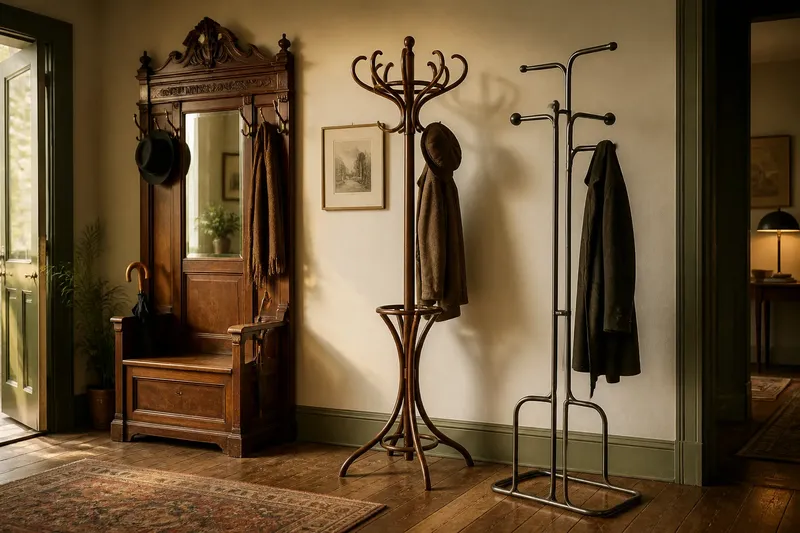
In nineteenth-century Victorian homes, the entrance hall could serve as a threshold between public street and private rooms. Hall trees addressed that busy transition by gathering coat hooks, a mirror, and sometimes an umbrella stand or bench into one piece of furniture. Their carved wood, turned posts, and shaped rails made the storage visible as part of the room’s furnishing.
The hall tree differed from a simple freestanding coat rack because it combined functions and occupied more space. Its mirror let a person check their appearance on arrival or departure; its hooks kept garments near the door. The form expressed a Victorian interest in furnished interiors, but it also answered an ordinary household problem: a coat needed a place before its owner moved farther into the home.
These pieces varied in ornament and construction, so “Victorian hall tree” does not describe one fixed design. The useful distinction is the combination of storage and display. A carved frame could make the entrance feel furnished, while the hooks and compartments kept everyday objects close at hand.
Bentwood made the coat stand read as a continuous line
By the late nineteenth century, bentwood furniture offered another way to shape a coat stand. Michael Thonet’s bentwood furniture, made through a process of steaming and bending wood, is a well-known example of how curved timber could form light, repeated structures. Thonet’s coat racks used branching wooden arms and a central upright, turning the logic of a tree into a practical arrangement for hats and coats.
Compared with a carved hall tree, a bentwood rack could look more open. Its curved arms traced the structure instead of enclosing it in a cabinet-like frame. That difference mattered in a hallway: the stand still held outerwear, but its outline left more of the surrounding wall visible.
The design also made construction part of the appearance. Curved components showed how the arms extended from the post, much as a spoon’s handle and bowl reveal the shape required by its task. The result was decorative without hiding the object’s working logic.
Modernist metal frames emphasized lightness and structure
In the twentieth century, modernist furniture designers often favored clear structure, reduced ornament, and materials such as tubular steel. Marcel Breuer’s tubular-steel furniture is a familiar reference for this approach, though not every metal coat stand belongs to a single movement or maker. A narrow metal frame could make hooks and supports seem spare, while the material’s bends and joins remained easy to read.
This was a visual contrast with the substantial wood and carved detail of many hall trees. A slender frame did not need to imitate branches or furniture cabinetry. It could present itself as a line in space, with a small set of projections doing the work of holding garments.
Metal did not automatically make a stand stable or elegant, any more than wood guaranteed a heavy appearance. The form depended on its base, joints, finish, and proportions. A broad base could anchor a narrow stem; a carefully arranged group of hooks could keep a simple outline useful rather than merely abstract.
Design history still turns on how the stand carries coats
The coat stand’s changing role is clearest when its silhouette is read alongside its use. A Victorian hall tree gathered several household functions into a substantial piece; a bentwood rack made the branching support visible; a modernist metal frame could reduce the object to a legible arrangement of lines. None abandoned the original job. Each made a different choice about how much structure, ornament, and visual weight that job required.
Imagine a homeowner furnishing a narrow entry with a carved hall tree inherited from a relative. They notice that its mirror and storage suit the household, but its deep frame crowds the doorway. They move it to a wider wall, then place a slim bentwood-style rack near the entrance for daily coats. The expected result is a clearer route through the hall, with the older piece still serving as furniture rather than being mistaken for a failed version of the lighter rack.
That comparison is useful because it avoids treating one style as the inevitable successor to another. A hall tree may suit an entrance that can accommodate its depth and several functions. A more open stand may make sense where a visible wall and a lighter outline matter more.
What details help distinguish coat stand forms?
What is the difference between a hall tree and a coat stand?
A hall tree typically combines coat storage with other features, such as a mirror, bench, or umbrella holder. A coat stand is usually a more focused arrangement of a post or frame with hooks.
Why does bentwood appear in coat stand history?
Bentwood made it possible to form curved arms from shaped timber, giving some racks an open, branching outline. The curves could be both structural and decorative, rather than applied ornament separate from the support.
What makes a metal coat stand look modernist?
A spare frame, visible bends or joints, and limited surface ornament can recall modernist design priorities. The material alone is not enough; the arrangement of the parts matters too.
How can I identify what a coat stand is meant to hold?
Look at the spacing, height, and shape of its hooks, along with the stability of its base. Short, closely grouped hooks may suit hats or light garments, while long coats need room to hang without overlapping heavily.
Form and material still shape the entrance
For a modern entry, the historical distinctions offer a practical way to read a coat stand before choosing one. A carved hall-tree form brings visual mass and often combines storage; a branching bentwood form emphasizes curves and openness; a slender metal frame makes its structure prominent. These are useful comparisons, not strict rules: makers and later reproductions vary in detail.
- Check the silhouette. If a carved frame makes the entry feel crowded, then consider a more open branching form; if the wall looks bare, then a substantial hall-tree shape may suit it better.
- Check the added functions. If a mirror, bench, or umbrella storage would be used, then a hall-tree form can consolidate them; if not, choose a simpler stand and leave those features out.
- Check the material and visible construction. If curved timber is the appeal, then look for arms that clearly meet the upright; if a spare outline is preferred, then compare metal frames with restrained joints and finishes.
- Check hook spacing against the garments. If long coats overlap on the hooks, then choose a form with more separation or reserve some hooks for hats and bags; if garments hang freely, then the arrangement fits the current load.
- Check the base and floor area. If the base interrupts the walking route, then move the stand or consider a wall-mounted option; if the route remains clear, then its footprint works in that location.
- Check whether the piece is original or a later interpretation. If a seller provides a maker, date, or construction record, then compare those details with the object; if documentation is absent, then describe it by its visible style and materials rather than assigning a precise period.
For a wall-mounted fixture, follow the maker’s hardware instructions and consult a qualified professional if the installation is beyond your experience. The coat stand’s history is most useful when it sharpens what you see: a branching arm, a carved frame, or a bent metal line can all make the entrance work, but each gives the room a different character.