Why a Jacket’s Shoulder Seam Changes Its Line
See how jacket shoulder seam placement changes the silhouette, then compare shoulder lines on a hanger and on your body before choosing a cut.
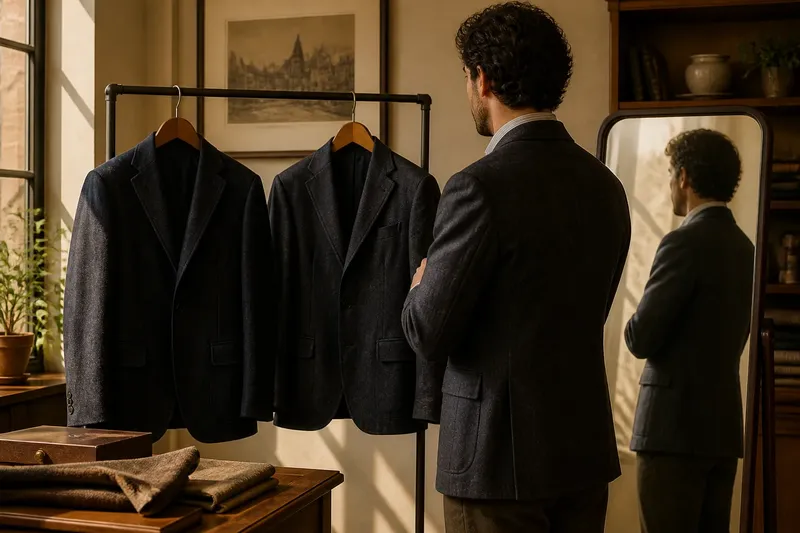
Where does a jacket’s shoulder seam sit, and why can that small detail make the whole garment look sharper, softer, or broader? Jacket shoulder seam placement sets the boundary between the body and sleeve, shaping the line your eye follows from neck to arm. Compare that line directly, and the jacket’s silhouette becomes easier to read.
Compare the shoulder line with a simple visual method
For a useful comparison, look at jackets in similar fabrics and sizes. A soft knit and a stiff wool jacket may hold their shoulders differently, so comparing unlike materials can obscure what the seam itself is doing.
Hang each jacket on the same broad, smooth hanger, close the front, and let the sleeves fall naturally. Stand at eye level with the shoulder rather than looking down. Follow the top edge from the neckline toward the sleeve, then note where the seam turns and where the sleeve begins to drop. Repeat the comparison while wearing each jacket, viewed from the front and side. The hanger reveals construction; the body reveals the resulting line.
Think of the seam as the edge of a paper shape: move that edge outward, and the shape looks wider even if the fabric itself has not changed. The analogy is simple, but the garment has more going on. Sleeve fullness, padding, fabric stiffness, and fit through the chest all affect how the seam reads.
1. A seam at the shoulder point gives a clear boundary
In a conventional set-in sleeve, the seam usually sits near the point where the shoulder turns down into the arm. This placement draws a distinct line between jacket body and sleeve. The result often reads as defined and close to the wearer’s natural outline, especially in a fabric that holds a clean edge.
Look for the seam’s relation to the shoulder bone, not just whether it appears straight on a hanger. A seam can sit correctly while the sleeve still twists or pulls, and a relaxed fabric can make the boundary appear less crisp. On the body, check whether the shoulder line continues smoothly into the upper sleeve without a ridge or a hanging hollow.
2. A seam beyond the shoulder point adds width and ease
When a seam extends past the wearer’s shoulder point, the sleeve begins farther out. This can create a broader, more relaxed outline, with the shoulder seeming to stretch beyond the body. The effect is especially visible in a structured jacket, where padding or firm cloth holds the extension in place.
That extra width does not automatically mean a poor fit. Some cuts are designed to make the shoulder line feel expansive; others may simply be too large. Check the full silhouette: if the chest and sleeve also look roomy, the seam may be part of an intentionally generous shape. If the body fits closely but the shoulder droops, the proportions may feel less resolved.
3. A seam inside the shoulder point narrows the outline
A seam that sits inward of the shoulder point makes the sleeve begin sooner. This can give the upper body a compact, narrow appearance and may make the arm look more prominent by comparison. In a tailored jacket, the shorter shoulder line can read as precise; in a soft jacket, it may look understated and close-fitting.
Watch for strain rather than judging the seam location alone. If diagonal creases pull from the neckline toward the sleeve, or the upper arm feels restricted when you reach forward, the cut may be too tight for your movement. A narrower-looking shoulder can be a deliberate style choice, but it should not depend on the jacket being uncomfortable.
4. Padding and fabric can change what the seam appears to do
The seam marks a construction point, while the fabric and internal structure determine how strongly that point reads. A padded shoulder can hold a crisp, level edge. Unpadded wool may follow the body more closely, and a soft cotton jacket can let the sleeve settle into a rounded slope. The same seam position can therefore produce different visual effects.
Inspect the shoulder from the front and side. From the front, look for a smooth transition into the sleeve; from the side, notice whether the shoulder looks lifted, sloped, or extended. A seam hidden by a pronounced ridge may be less important to the visible line than the padding beneath it. A soft seam, meanwhile, may blend into the sleeve rather than announce a sharp boundary.
5. Sleeve shape and balance complete the shoulder line
The shoulder does not end at the seam. Sleeve width, armhole depth, and the way the jacket hangs through the chest all influence its outline. A roomy sleeve can make a moderate shoulder extension look more pronounced. A narrow sleeve may make the shoulder seem stronger by contrast.
Check how the jacket behaves with your arms resting at your sides and then moving naturally. The shoulder should not climb dramatically or pull the body of the jacket out of place. Also notice whether the sleeve hangs straight or angles forward; that angle can make an otherwise balanced shoulder look tilted. These observations help separate a shoulder-line preference from an issue elsewhere in the garment.
How should you compare jacket shoulder seams?
Should the seam end exactly at the shoulder bone?
Not always. A seam near the shoulder point creates a familiar, defined outline, but relaxed or deliberately broad cuts may place it farther out. Judge the line alongside the jacket’s overall shape and how it sits when worn.
Can a shoulder seam look different on a hanger?
Yes. A hanger supports the jacket without the shape of a person beneath it, and its width can distort the shoulder. Use the same broad hanger for each garment, then compare the jackets on the body for a more useful reading.
What should you notice from the side?
Look for a smooth slope from the neckline into the sleeve and check whether the shoulder seems lifted or dropped. Side views can also reveal a sleeve that angles forward or a padded edge that is difficult to spot from the front.
Does a dropped shoulder always mean the jacket is too big?
No. A seam below the shoulder point can be a planned feature of a relaxed cut. Consider whether the rest of the jacket shares that ease and whether the sleeve and body move comfortably together.
Use the line to decide what suits the jacket
Imagine you are comparing two dark wool jackets with similar body lengths. One has a seam near your shoulder point and a clean sleeve head; the other extends beyond it and falls into a softer sleeve. View both on the same hanger, then try them on and check the front and side. The first is likely to look more defined, while the second may read as broader and more relaxed. That visible contrast gives you a clear basis for choosing without treating either line as universally better.
Jacket shoulder seam placement is most useful as a clue, not a verdict. Start by locating the seam, then read the padding, fabric, sleeve, and fit as parts of the same outline. Once you can see where the jacket’s line leaves your own shoulder, you can choose whether you want that boundary to follow, soften, or extend beyond your frame.