The Woven Mark of a Basket’s Making
Learn to read a basket’s woven mark by spotting over-under weaving, coiling, and the structural clues that reveal how its pattern was made.
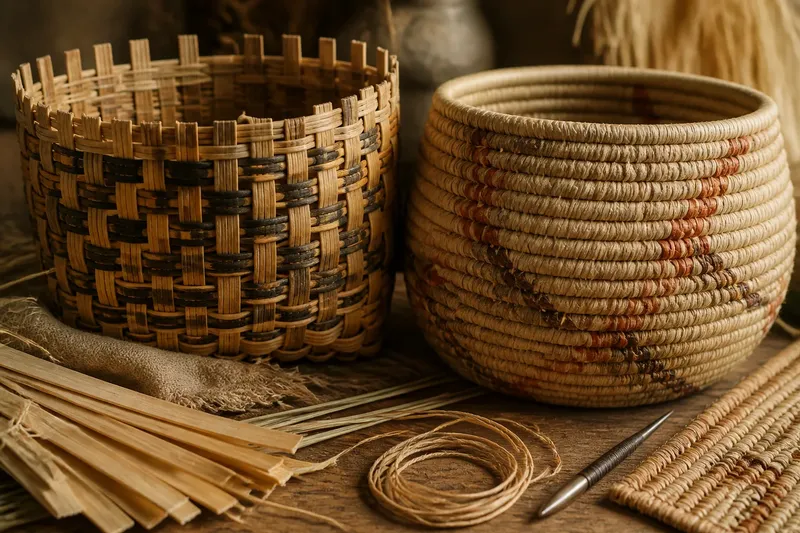
How can you tell whether a basket’s pattern comes from over-under weaving or coiling? Look closely at the walls: one method crosses separate strands, while the other builds a continuous spiral and stitches it in place. The distinction is more than a matter of appearance. It shows how the basket’s structure produces its visible mark.
A basket can present a smooth surface, a bold grid, or a pattern that seems to turn around itself. Those effects begin with a few practical choices: what serves as the foundation, which material bends around it, and how each new part connects to the last. Once you know what to look for, the surface becomes a record of construction rather than decoration alone.
What does over-under weaving look like?
Over-under weaving uses at least two sets of elements. One set runs in one direction; another crosses it. The crossing material passes over one element and under the next, then changes position as it continues. Repeating that sequence creates the familiar checker of a plain weave.
On a basket, the upright elements are often called stakes or spokes. They form a framework that the weaver works around with a flexible strand called a weaver. Depending on the basket and the materials, the framework may be made of rigid splints, reed, willow, or other locally used materials. The names and preparation vary, but the visual relationship is easy to spot: one set stays comparatively straight while another travels across it.
Watch for the surface rhythm. A weaver passing over one stake and under the next makes small, regular interruptions along the uprights. The pattern can read as a grid, though curved walls bend the grid into the shape of the vessel. A tight weave may make the crossing points seem almost seamless. A more open weave leaves clear gaps and makes the route of each strand easier to follow.
Not every woven pattern uses a simple one-over, one-under sequence. In twill, a strand may pass over several stakes before going under others, with the crossing point shifting on each row. That shift can form diagonal ribs or longer slanting bands. The crucial clue remains the crossing: separate strands intersect, even when the pattern makes those intersections less obvious.
How can coiling be recognized?
Coiling builds a basket from a continuous foundation that circles around itself. A stitch binds each new round to the round below, so the structure grows outward and upward in a spiral. Rather than crossing a set of upright stakes, the maker joins one coil to another.
Look for a repeated horizontal course around the wall. It may resemble a stack of narrow rings or a low ridge that winds around the basket. The stitches can appear as small diagonal, vertical, or slanting marks linking one round to the next. Their direction and visibility depend on the material, stitch, and finish. On a closely worked basket, the binding may sit so neatly that the coil structure is subtle.
Coiling does not require a single kind of foundation. Makers may use bundles of grass, pine needles, split material, or other flexible fibers, then wrap or stitch them together. The visible surface can be plain, patterned with dyed fibers, or decorated with a separate design. Whatever the ornament, the underlying clue is the same: successive courses are joined by stitches rather than by weaving a strand across a standing framework.
In some baskets, the stitch is easier to see on the inside or underside. Turn the object only if it can be handled safely and respectfully; a fragile rim or loose fiber can be damaged by casual inspection. If the basket is in a collection or belongs to someone else, a close view from different angles may be enough.
Which details reveal the construction?
Start with the rim and base, then follow the structure into the wall. The rim often shows how the working elements end or turn. A woven basket may have upright stakes folded, tucked, or bound into a finished edge. A coiled basket may show the final course secured to the one beneath it. Finishing can conceal these differences, so treat the rim as one clue rather than a verdict.
The base can offer a clearer view. In many woven forms, stakes begin at or pass through a central arrangement, then spread outward as the base takes shape. In coiled forms, the foundation may spiral from the center, with each course attached to the one before. Look for a continuous turning path rather than expecting a particular center pattern; makers use different starting methods, and repairs can alter what you see.
Next, trace one strand with your eye. A woven weaver crosses other elements and changes from front to back. A coil’s binding stitches repeatedly connect neighboring rounds. If the fibers are too dense to follow, inspect where the wall meets the base, where an edge turns, or where a pattern changes. These transitions often expose the construction more clearly than a broad, even patch.
Materials can offer supporting clues, but they cannot settle the question on their own. Reed, willow, cane, grasses, and split wood can be prepared in different ways, and similar materials can serve different structural roles. Color is also unreliable as a shortcut: contrasting strands may make a weave easier to see, while a dyed coil can create a pattern that resembles interlacing at a glance.
Why do the patterns look so different?
The structure sets the basic possibilities, but spacing, strand width, material stiffness, and color shape the final appearance. A broad, flat weaver creates a different surface from a narrow round one. Closely spaced stakes can make a woven wall look nearly solid; wider gaps emphasize the framework. Coiling can produce a rounded, ridged texture or a smoother surface, depending on the foundation and stitching.
Pattern often comes from changing a repeated action. In a woven basket, the maker might vary the over-under sequence, group strands, or switch colors to form bands and checks. In a coiled basket, changes in stitch, material, or color can mark the spiral course by course. These effects may look decorative, but they remain tied to the way the structure is assembled.
Think of the difference as a window screen and a rolled cord mat. The screen’s crossing threads make a grid; the cord mat grows through repeated turns held together. Neither analogy describes every basket, but each helps separate crossing from coiling. The basket’s curve, dense finish, or decoration may disguise the pattern, so return to the actual meeting points of the fibers.
Imagine you find a small basket with a dark band around its middle. At first, the band looks like a stripe laid over a woven grid. On closer inspection, each dark strand crosses the upright stakes in the same over-under rhythm as the pale strands, so the color change belongs to the weave itself. If instead the dark band follows a continuous horizontal course and small stitches link it to the course below, the visible stripe is part of a coiled structure. The observable difference is where the fibers connect, not merely the shape of the color band.
What questions help identify a basket’s structure?
Can a basket combine weaving and coiling?
Yes. A basket may use one structure for its base or body and another for a rim, handle, or decorative section. Examine each part separately, since the construction can change at a join.
Does a tight pattern mean the basket is woven?
No. Both weaving and coiling can produce a dense surface. Look for crossing strands or for stitches connecting successive courses; density alone does not identify the method.
Can color tell me how a basket was made?
Color can make a pattern easier to follow, but it does not reveal the structure by itself. Trace the colored material to see whether it crosses stakes or follows and binds a coil.
What if I cannot follow any strand?
Try a different viewing angle and focus on the base, rim, or a change in direction. If the surface remains unclear, describe what you can observe without assigning a method; wear, finish, and repairs can obscure the original construction.
How should a viewer describe what they see?
Begin with visible facts: “The wall has upright stakes crossed by a strand,” or “The surface forms repeated courses joined by small stitches.” Then name the likely structure if the evidence supports it. This keeps the description useful even when a finish hides part of the work or a repair interrupts the pattern.
For an unfamiliar basket, note where the pattern changes and whether the same construction continues from base to rim. A close, oblique view can reveal the depth of a crossing; a view from above may clarify a spiral. Avoid pulling fibers apart to expose the structure. If identification matters for conservation, attribution, or handling, consult a qualified basketry specialist or curator rather than relying on a guess from the surface.
The woven mark of a basket is easiest to read where the fibers meet: at a crossing, a stitch, a turn, or a finished edge. Keep that small question in view—what is joined to what? It can turn a patterned surface into a clear account of how the basket was made.